.svg)


New
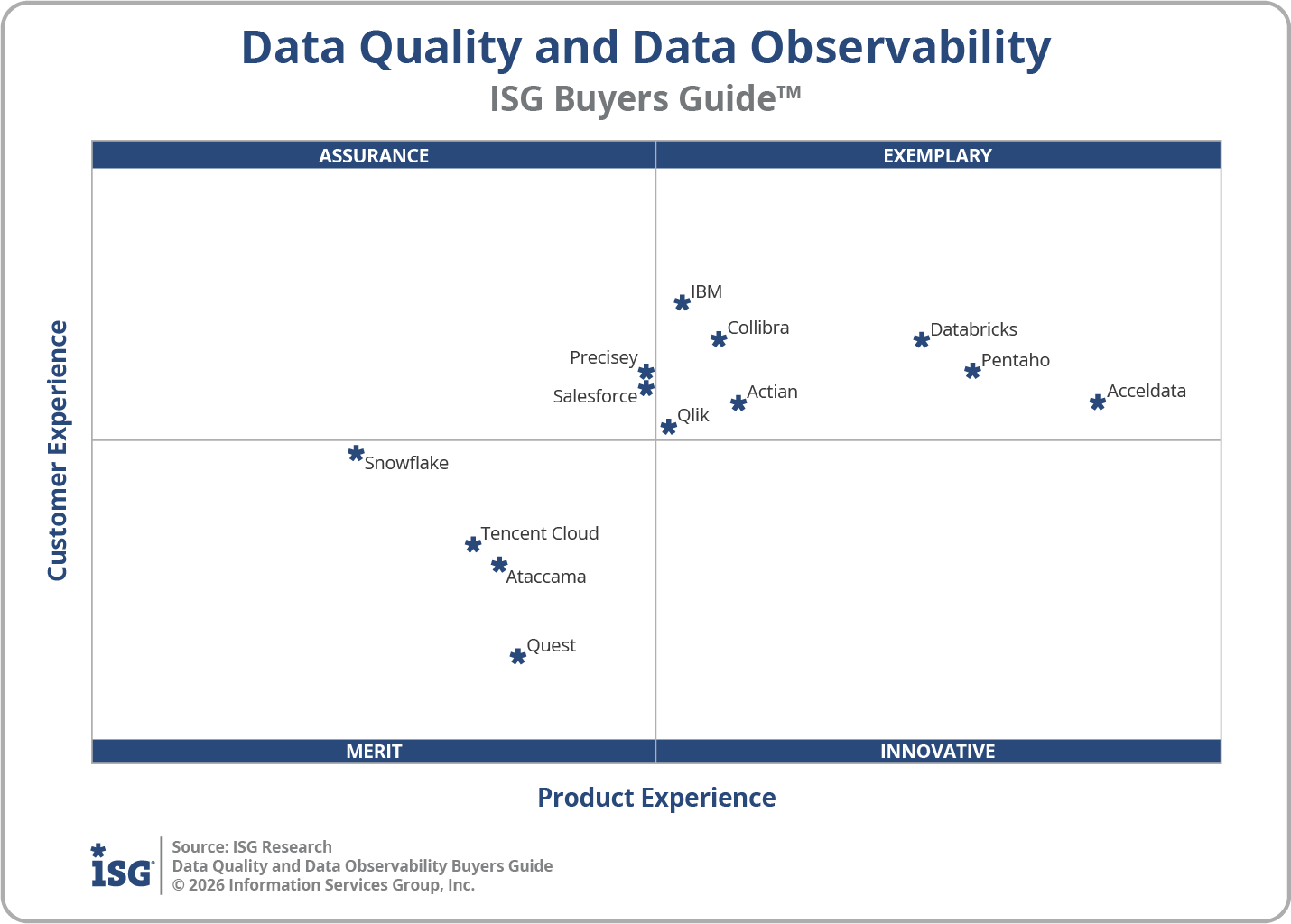
Acceldata recognized as an Exemplary Leader in 2026 ISG Buyers Guide™ for Data Quality and Data Observability. Read the Report→
Platform Overview

Data & AI Observability
Agentic Data Engineering
Data Warehousing
Agentic Runtime
Agentic Data Management
Hadoop Modernization
Platform Overview
Everything you need to build, govern, and scale data and AI workloads—one unified platform.
xLake Architecture

CAPABILITIES
Manage your data estate under one platform
Explore Integrations


Data & AI Observability
Monitor, detect, and resolve data and AI issues with end-to-end observability across pipelines.
Explore
Agentic Data Engineering
Build, orchestrate, and run data pipelines with intelligent agents that automate the entire engineering workflow.
Explore ADE
Data Warehousing
Query your lakehouse in-place with Velox-accelerated performance. 10x faster than traditional warehouses.
Explore Data Warehousing
CAPABILITIES


Agentic Runtime
Distributed training, high-throughput inference, and GPU notebooks—everything you need for production AI.
Explore
CAPABILITIES


Agentic Data Management
Build, deploy, and manage intelligent agents to automate and optimize data operations.
Explore ADM

Industries
Browse solutions to help you solve the complex business challenges unique to your industry.
4+ hrs → 15 min
to validate critical lending data
to validate critical lending data
Learn More
40+
enterprise data products with unified health visibility
enterprise data products with unified health visibility
Learn More
20% → 90%
sales forecast confidence score
sales forecast confidence score
Learn More
4+ hrs → 15 min
to validate critical lending data
to validate critical lending data
Learn More
39 mos → 12 mos
to clinical candidate selection
to clinical candidate selection
Learn More
4+ hrs → 15 min
to validate critical lending data
to validate critical lending data
Learn More
Resources
Browse materials to help you access the tools, guides, and insights essential to your workflows.


Company
Learn about our mission, leadership, and vision driving modern data operations forward.


Products

Industry
Resources
Company

Back
Platform Overview
Data & AI Observability
Agentic Data Management
Agentic Data Engineering
Data Warehousing
Data Science
Data Platform Modernization
Back
Industries
Browse solutions to help you solve the complex business challenges unique to your industry.
Explore Case Studies
4+ hrs → 15 min
to validate critical lending data
to validate critical lending data
Learn More
Back
Resources
Browse materials to help you access the tools, guides, and insights essential to your workflows.
Back
Company
Learn about our mission, leadership, and vision driving modern data operations forward.
Back
Platform Overview
Everything you need to build, govern, and scale data and AI workloads—one unified platform.
xLake Architecture
CAPABILITIES
Manage your data estate under one platform
Explore Integrations
Back
Data & AI Observability
Monitor, detect, and resolve data and AI issues with end-to-end observability across pipelines.
Explore
Back
Agentic Data Management
Build, deploy, and manage intelligent agents to automate and optimize data operations.
Explore ADM
Back
Agentic Data Engineering
Build, orchestrate, and run data pipelines with intelligent agents that automate the entire engineering workflow.
Explore ADE
Back
Data Warehousing
Query your lakehouse in-place with Velox-accelerated performance. 10x faster than traditional warehouses.
Explore Data Warehousing
CAPABILITIES
Back
Agentic Runtime
Distributed training, high-throughput inference, and GPU notebooks—everything you need for production AI.
Explore
CAPABILITIES


TRUSTED BY ENTERPRISE DATA TEAMS WORLDWIDE









Built for the infrastructure you already run.
No migration required.

Kubernetes-Native Execution
Deploy on EKS, AKS, GKE, or on-premises Kubernetes without modification. Portability and conformance across every environment you run today.

Decoupled Compute and Storage
Each scales independently. Spark, Trino, Jupyter, and Airflow each get their own workload cluster — none share resources or contend with each other.

Decoupled, Open Architecture
Compute, storage, governance, and intelligence each evolve independently. Built on Apache-licensed open source throughout. No proprietary runtime. No locked-in formats. Your architecture stays yours.

Open Data Formats
ODP-compatible orchestration, open DAG authoring, and S3-compatible storage. Parquet, ORC, Delta, Iceberg — no proprietary formats. No lock-in. Your data stays portable at every execution layer.

Tunnel Client Security Model
Control plane connects to your data plane via outbound-only tunnel from your environment. Your data never leaves your VPC. Zero vendor access. Compliance posture is unchanged.

Single Control Plane
One interface. Scheduling, orchestration, scaling, observability, and AI-assisted authoring across all environments — on-prem, AWS, Azure, and GCP simultaneously.
Split-plane Architecture. Your data never moves.
What managed platforms hide — and what your engineers are burning hours trying to reconstruct manually.
Data Plane
Your Environment
Your VPC. Your Perimeter. Always.

Kubernetes: EKS, AKS, GKE, or on-premises
S3-compatible object storage — no HDFS triple replication overhead
Spark runtime executes inside your cluster, against your data
Zero data egress to Acceldata infrastructure
Control plane
Acceldata Managed
Your VPC. Your Perimeter. Always.
.svg)
Pipeline scheduling and DAG execution
Workload-aware resource allocation and right-sizing
Adaptive scaling across ETL, SQL, ML, and inference
AI-assisted authoring and smart scheduling

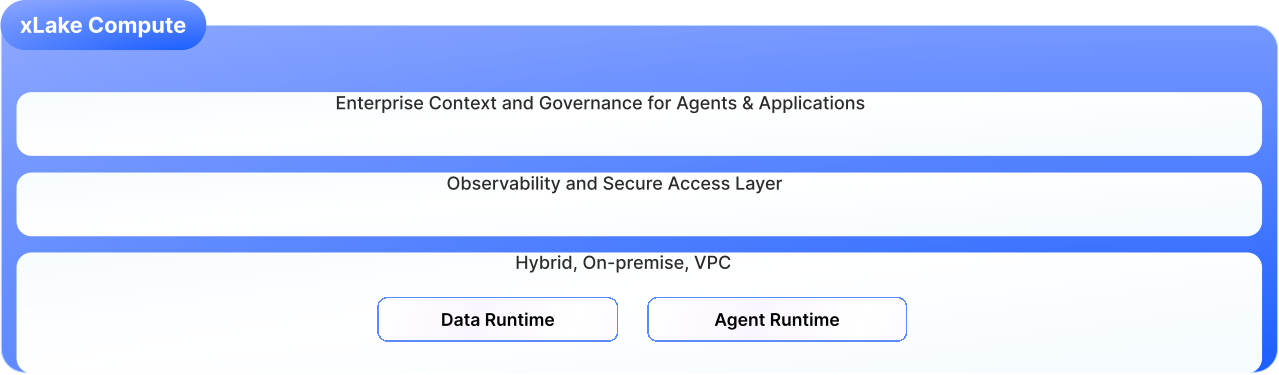
xLake Platform
Cross Lake Data Platform
xCompute — execution layer
Multi-engine workload execution with per-user governance enforcement
Apache Spark
Trino
Jupyter
Airflow
xStore — catalog layer
Federated metadata and catalog management across storage systems
Apache Iceberg
Gravitino
Hive Metastore
S3 · ODP · HDFS
xCentral — governance layer
Policy enforcement, secrets management, and access control
Apache Ranger
Keycloak
RBAC
Kubernetes data plane — your infrastructure
EKS
AKS
GKE
On-premises K8s
Go deeper into agentic AI architecture
The shift to agentic AI changes how data platforms need to handle reliability, governance, and automated operations. This guide breaks the architecture down into four clear levels.
Everything your data platform can do
Every stakeholder gets the answer they need — in their language, in the same thread, right now.

Run Anywhere, Without Refactoring
Spark, SQL analytics, ML training, and AI inference run natively. 98% of existing Spark applications migrate without modification.

Multi-Environment Orchestration
Schedule and manage pipelines across on-prem, AWS, Azure, and GCP from a single control plane. Open DAG authoring, no workflow lock-in.

Workload-Aware Resource Management
Independently size compute for each workload type — ETL, SQL, ML, inference. Stop paying peak-cluster prices for jobs that don't need it.

AI/LLM-Assisted Pipeline Authoring
Generate orchestration logic from natural language, YAML, or SQL. Built into the authoring workflow.
.svg)
Adaptive Scheduling and Scaling
Continuous resource optimization in the background — lower compute costs, no manual tuning.
Observability and Monitoring
Full pipeline visibility across environments, built in — not a separate product to integrate.
Migration Tooling
Ships with the platform. Existing Spark applications migrate in hours, not weeks.
Data Residency Controls
All compute runs in your environment. All data stays in your perimeter. Always.
What You Stop Paying For
xLake eliminates the structural cost drivers in traditional data infrastructure


Infrastructure TCO

Storage costs

Compute waste
.svg)
Migration timelines

Pipeline authoring time
Before xLake
With xLake
Baseline
35–45% reduction
via independent compute and storage scaling
via independent compute and storage scaling
HDFS triple replication
50–65% savings
with object storage durability
with object storage durability
Fixed clusters, no workload awareness
15–25% YoY reduction
via right-sized, workload-specific clusters
via right-sized, workload-specific clusters
Weeks of re-architecture
Hours
98% of workloads run without refactoring
98% of workloads run without refactoring
Manual DAG development
Accelerated with AI/LLM-assisted generation


Built for Enterprise Use Cases
What managed platforms hide — and what your engineers are burning hours trying to reconstruct manually.

Vendor Platform Exit
Run existing Spark workloads without modification. Compress migration timelines from months to hours — no replatforming project required.

Hybrid and Multi-Cloud Unification
One execution layer across on-prem and multiple clouds — not three separate platforms with three separate operational models.

Infrastructure Cost Reduction
35–45% TCO reduction via independent compute-storage scaling and workload-aware resource allocation — without pipeline changes or SLA risk.

Regulated Industry Deployments
Data residency, sovereignty, and compliance requirements met by design. All data and compute stay in your environment.

Data Engineering Productivity
Stop spending engineering hours on cluster management and scheduler upkeep. xLake shifts operational responsibility to the Acceldata control plane.

AI and ML Pipeline Operationalization
Workload-specific compute for production inference — not a one-size cluster shared with ETL jobs.
Dominate with Data
40%
reduction in pipeline
downtime
downtime

30%
faster time-to-model
deployment
deployment
25%
lower cluster costs
99.9%
SLA adherence on
migrated workloads
migrated workloads
Ready to get started
Explore all the ways to experience Acceldata for yourself.