




.svg)




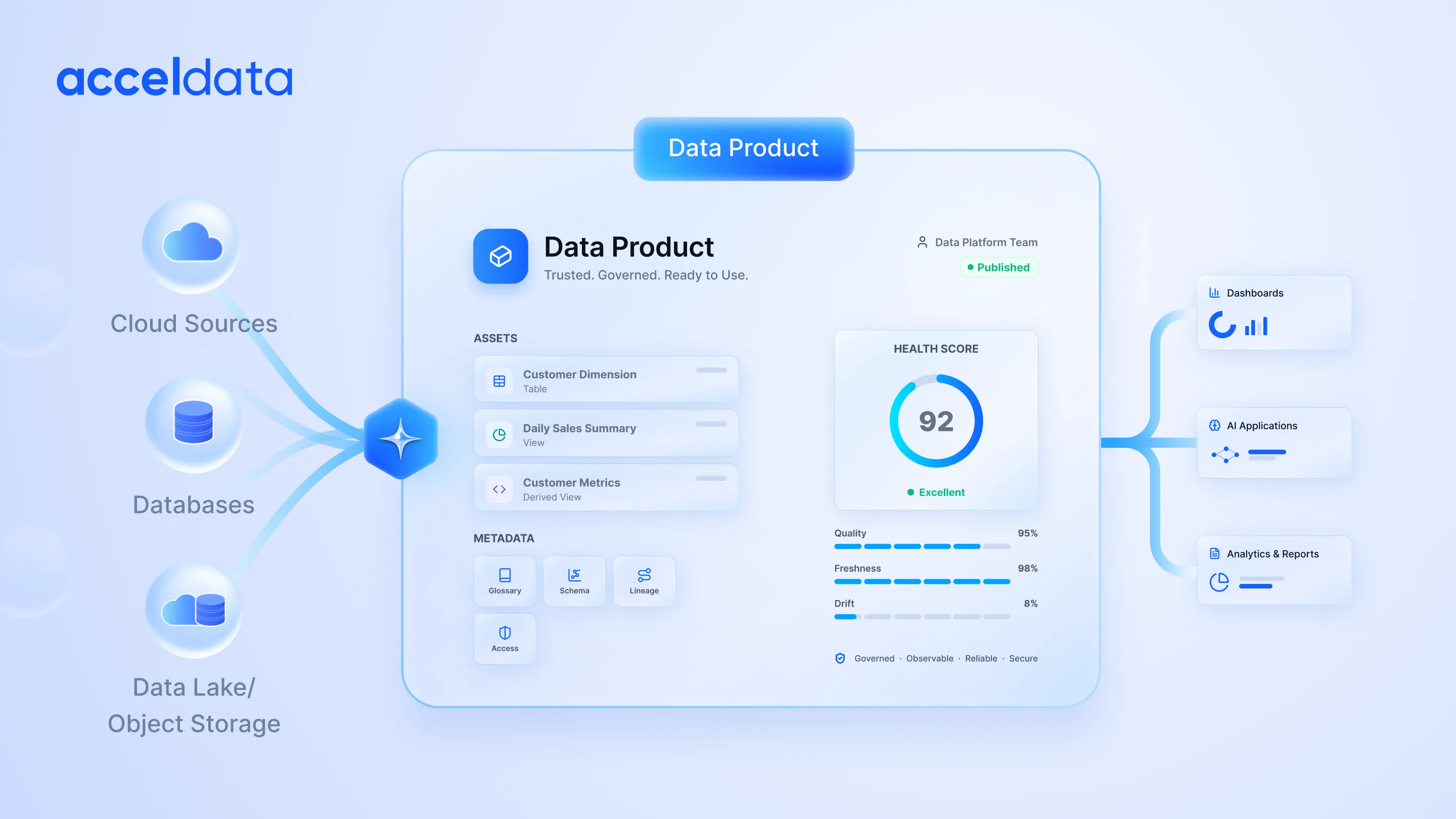
High-performing organizations operationalize governance by embedding it directly into platforms, automating enforcement, and using metadata as a real-time control layer. The result is governance that executes continuously, scales effortlessly, and keeps pace with how data is actually produced and consumed.
If your organization manages thousands of data assets, governance can no longer live on the sidelines. It must function like infrastructure—always on, reliable, and largely invisible.
Traditional governance looks strong on paper, but manual reviews and static rules inevitably break down when data moves at scale. Enforcement lags, complexity grows, and governance turns into friction rather than protection, forcing teams to bypass it just to deliver.
This isn't a failure of effort, but of design. Operationalizing governance means embedding it directly into the platforms where data lives. Instead of relying on human intervention, policies must execute automatically, driven by real-time metadata.
At enterprise scale, governance must move at the exact speed of your data. It should adjust dynamically and stay entirely out of the way until it actively prevents a failure. That is the fundamental shift from governance as mere documentation to governance as infrastructure.
Why Governance Breaks at Asset Scale
Governance rarely breaks all at once; it erodes slowly as your data environment grows. At a small scale, manual governance feels manageable through data stewards and checklists.
But as your organization moves from hundreds of assets to thousands, that model collapses under its own weight:
- The Volume Problem: Every new table, dashboard, pipeline, or model multiplies the number of decisions governance must make. Human-driven processes simply cannot keep up with the pace at which assets are created and modified.
- System Fragmentation: Data spreads across warehouses, lakes, streaming platforms, BI tools, and ML systems. Because governance tools often only see pieces of the picture, policies live in one place while enforcement lives in another, leading to inconsistent or delayed decisions.
- Reactive Timing: Traditional governance discovers issues during audits or incidents—after data has already been exposed or misused. At enterprise scale, delayed enforcement is effectively no enforcement at all.
- Disconnected Execution: Policies are documented but not embedded. Controls are defined but not automated. When teams are forced to remember rules while racing to deliver, governance turns into friction rather than protection.
Ultimately, governance at the asset scale does not fail due to a lack of policies. It fails because it was never designed to execute continuously across fast-moving, distributed data systems.
Core Operating Model for Scaled Governance
When governance is expected to scale, the operating model matters more than the toolset. You can invest in catalogs, scanners, and policy engines, but without the right model, governance still slows down and breaks under pressure.
At enterprise scale, governance must be designed to execute continuously across distributed systems, not coordinate decisions through centralized teams.
A scalable operating model treats governance as part of the data platform itself. Policies are defined once, context is continuously updated, and enforcement happens automatically wherever data is created, moved, or consumed. This shift removes governance from the critical path of delivery while strengthening control.
Centralized Policy, Decentralized Execution
Consistency requires centralization. Speed requires decentralization. Enterprise policies around security, privacy, retention, and usage must be defined centrally to ensure alignment with regulatory and risk requirements. This guarantees that every team operates under the same rules, regardless of domain or technology.
Execution, however, must be decentralized. Policies should enforce themselves directly within data warehouses, pipelines, BI tools, and AI platforms.
Teams should not need to request approvals or wait for reviews to do their work. Instead, they operate freely inside pre-defined guardrails. This model replaces approval-driven governance with execution-driven governance.
Metadata as the Control Plane
At scale, metadata becomes the system of record for governance decisions. Static documentation cannot capture how data actually behaves. Metadata fills that gap by continuously describing what data is, where it came from, how it is used, and who depends on it. Ownership, lineage, sensitivity, freshness, and access patterns all feed into governance logic.
When metadata is treated as a control plane, governance decisions become dynamic and contextual. Policies adapt automatically as data evolves. Without metadata intelligence, governance is reduced to guesswork and manual intervention.
Automation as the Force Multiplier
Automation is what allows governance to keep pace with data velocity. Manual tagging, policy application, and review workflows do not scale beyond a certain point.
Automation replaces repetitive governance tasks with consistent execution. New assets are discovered automatically. Controls are applied instantly. Violations are detected and addressed in real time.
This allows a small governance team to support thousands of assets without becoming a bottleneck. Automation does not remove governance oversight. It removes governance friction.
Governance Capabilities Required at Scale
At enterprise scale, governance does not fail because of missing intent. It fails because the underlying capabilities cannot keep up with how fast data changes. When thousands of assets are created, modified, and consumed daily, governance must be built on capabilities that execute continuously and adapt automatically.
These capabilities are not optional enhancements. They are foundational requirements for governance to function in modern data environments.
Asset Discovery and Classification
Visibility is the starting point of scaled governance. In large enterprises, new data assets appear constantly. Tables are created automatically. Pipelines generate intermediate datasets. Dashboards and models are spun up by multiple teams. Manual inventories fall out of date almost immediately.
Continuous discovery ensures governance systems always know what exists, where it lives, and how it is connected. Classification must also happen automatically. Sensitivity, domain context, and data type cannot depend on humans remembering to tag assets.
Automated discovery and classification allow governance to act the moment data is created, not after it becomes a problem.
Policy Inheritance and Reuse
Governance breaks when policies have to be rewritten over and over. At scale, policies must be reusable and hierarchical. Controls applied at the domain, product, or sensitivity level should automatically extend to all associated assets. New tables, pipelines, and views inherit policies by default without additional configuration.
This approach dramatically reduces governance overhead while increasing consistency. Teams do not need to think about compliance every time they create something new. Governance is already in place. Policy inheritance is what allows governance to grow with the data ecosystem instead of chasing it.
Continuous Monitoring and Enforcement
Static enforcement cannot protect dynamic environments. Data changes constantly. Access patterns evolve. Lineage shifts. What was compliant yesterday may become risky today. Governance systems must monitor these changes continuously and respond in real time.
Continuous monitoring ensures policies are not just defined but actively enforced. When violations occur, controls trigger immediately. Access can be restricted. Alerts can be prioritized. Risks are contained before they spread downstream.
This transforms governance from a periodic check into a continuously executing system that keeps pace with enterprise data operations.
Governing Thousands of Assets Without Bottlenecks
When governance creates bottlenecks, it is no longer doing its job. In large data environments, bottlenecks do not appear because teams are careless. They appear because governance processes were designed for a world where assets were few, changes were slow, and decisions could be reviewed one at a time. That world no longer exists.
As thousands of tables, dashboards, pipelines, and models are created continuously, governance must keep up without inserting friction into daily work. This means removing humans from routine enforcement decisions and letting systems handle them automatically. Policies should be applied the moment an asset is created, not after a request is submitted and reviewed.
The most effective governance models rely on guardrails instead of gates. Teams are free to build and iterate, but always within clearly defined boundaries. If an asset violates policy, enforcement happens immediately and consistently, without negotiation or delay.
Human involvement shifts to where it adds the most value. Governance leaders focus on defining policies, reviewing systemic risks, and handling true exceptions instead of approving every access request or asset change. This reduces fatigue on both sides while improving compliance.
When governance is embedded directly into data platforms, it becomes invisible during normal operations and decisive during failures. That is how enterprises govern thousands of assets without slowing innovation or overwhelming teams.
Measuring Governance Effectiveness at Scale
At enterprise scale, governance that cannot be measured cannot be improved. Many organizations believe governance is working because policies exist, audits pass, or documentation looks complete. But those signals say little about whether governance actually executes in real environments where data is constantly changing.
Effective measurement focuses on outcomes, not artifacts. Instead of counting policies or stewards, you measure how consistently rules are enforced and how quickly issues are resolved. The goal is to understand whether governance operates continuously or only during reviews.
High-maturity organizations track governance coverage across data assets, pipelines, and access points. They monitor how often enforcement happens automatically versus requiring manual intervention. They measure the time between a violation appearing and corrective action taking place.
Equally important is measuring impact. Fewer downstream incidents, reduced rework, and higher trust in analytics indicate that governance is preventing problems before they spread. These outcomes show governance is functioning as an execution system, not just a compliance layer.
At scale, the most meaningful metrics answer a simple question: Is governance protecting the organization without slowing it down?
Common Failure Patterns
Most data governance programs do not fail because leaders ignore risk. They fail because the governance model cannot keep up with reality.
One of the most common failure patterns is treating governance as a documentation exercise. Catalogs grow, ownership fields are filled, and policies are written, but enforcement remains manual or inconsistent. Visibility improves, yet risk still slips through because nothing is actually executed.
Another frequent issue is over-reliance on stewardship. Human reviewers become approval gates for access, classification, and exceptions. As asset volume increases, review queues grow, decisions are delayed, and teams start bypassing governance altogether just to keep work moving.
Many organizations also separate policy definition from enforcement. Rules are defined centrally but left to individual teams or tools to interpret. Over time, enforcement drifts, exceptions pile up, and governance weakens quietly without anyone noticing.
The most damaging assumption is that governance scales with headcount. It does not. At enterprise scale, governance only works when it is engineered as a system that executes continuously, adapts automatically, and removes humans from routine control paths.
Governance Must Execute, Not Just Exist
When governance relies on manual reviews and disconnected spreadsheets, it doesn't just slow down the business; it eventually stops protecting it. To thrive at scale, enterprises must stop treating governance as a "check-box" exercise and start treating it as data observability in action.
This is where the shift happens. By unifying real-time observability with automated policy execution, Acceldata transforms static documentation into an active, invisible infrastructure. Our platform turns your metadata into a dynamic control plane, ensuring that every asset—no matter how fast it moves or how far it travels—is automatically discovered, classified, and protected without ever hitting a human bottleneck.
Don't let your governance model become the ceiling for your innovation. Move beyond visibility and into machine-scale control with a platform designed for the complexity of the modern enterprise. Schedule a demo with Acceldata today to see how we turn governance from a business blocker into a competitive advantage.
FAQS
Does automated governance replace the need for data stewards?
No. Instead, it elevates their role. Automation handles the high-volume, repetitive tasks—like tagging thousands of tables or applying standard access rules. This frees up data stewards to focus on high-value strategy, such as defining complex business logic, handling unique edge cases, and evolving policy frameworks to meet new regulatory requirements.
How does metadata act as a "control plane" for governance?
In a traditional model, documentation is static and quickly becomes obsolete. Using metadata as a control plane means your governance system "listens" to the data in real time. When an asset's metadata changes, the governance layer automatically detects the change and applies the relevant security or retention policies without human intervention.
Can we operationalize governance if our data is fragmented across different platforms?
Yes—and that is exactly when it is most necessary. A scalable operating model decouples policy definition from the underlying technology. By using a platform like Acceldata, you can define a policy once and have it enforced consistently across your entire ecosystem, whether your data lives in a cloud warehouse, an on-premises lake, or a streaming pipeline.
How do we ensure automation doesn't lead to "false positives" or accidental data blocking?
Effective automated governance is built on guardrails, not gates. By starting with high-confidence automated classifications and moving toward "alerting" before "blocking," organizations can tune their automation. Over time, as the system learns the environment’s access patterns and sensitivity levels, the "invisible" enforcement becomes more precise, reducing friction while maintaining ironclad security.